Capability-aware action surface
One protocol. Honest engine-specific controls.
Every adapter implements submit_task and advertises only the additional controls it can execute safely. The dashboard gates actions from the connected adapter's capabilities instead of pretending broker-specific operations are universal.
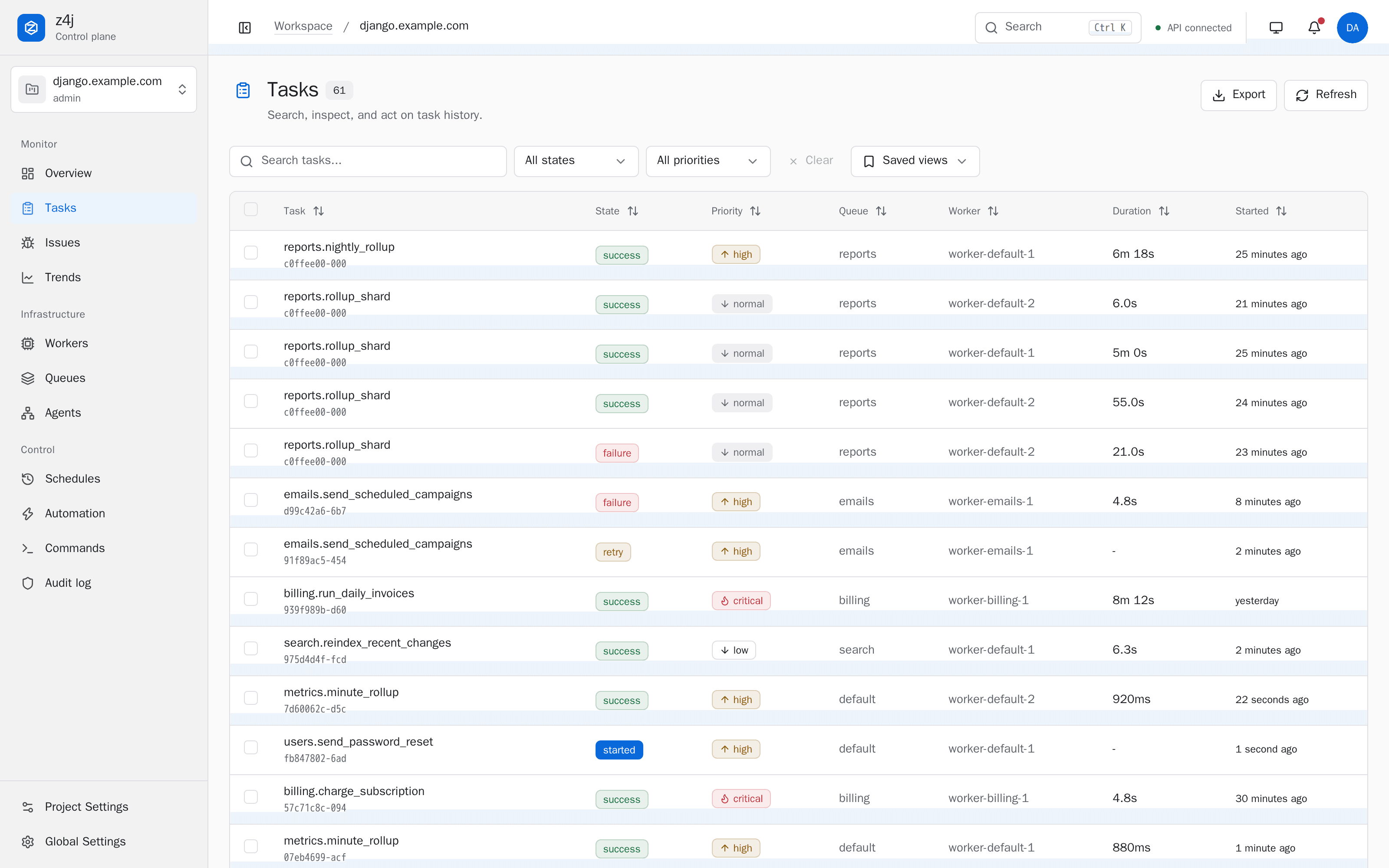
The related dashboard view, captured with sample project data. Open the live demo to try it.
Ships with
- Single Protocol method (submit_task) implemented by every adapter
- Retry and destructive controls require an advertised engine capability
- Dashboard hides or refuses controls the connected engine cannot honor
- A new engine advertises only the actions it can honor and refuses the rest
Highlights
- submit_task is the universal primitive
- Retries never replay the redacted argument copy stored by the brain
- DLQ replay stays engine-specific because consume/ack semantics differ
- Dead letters are read live from the engine's own store where the adapter can list it (RQ's failed registry, Dramatiq's .XQ queues)
Stuck-task reconciliation
Tasks started forever. Fixed, automatically.
A background worker sweeps tasks stuck in started/pending past a configurable threshold, asks the agent to probe the engine's result backend, and applies the authoritative state back with a task.reconciled audit row.
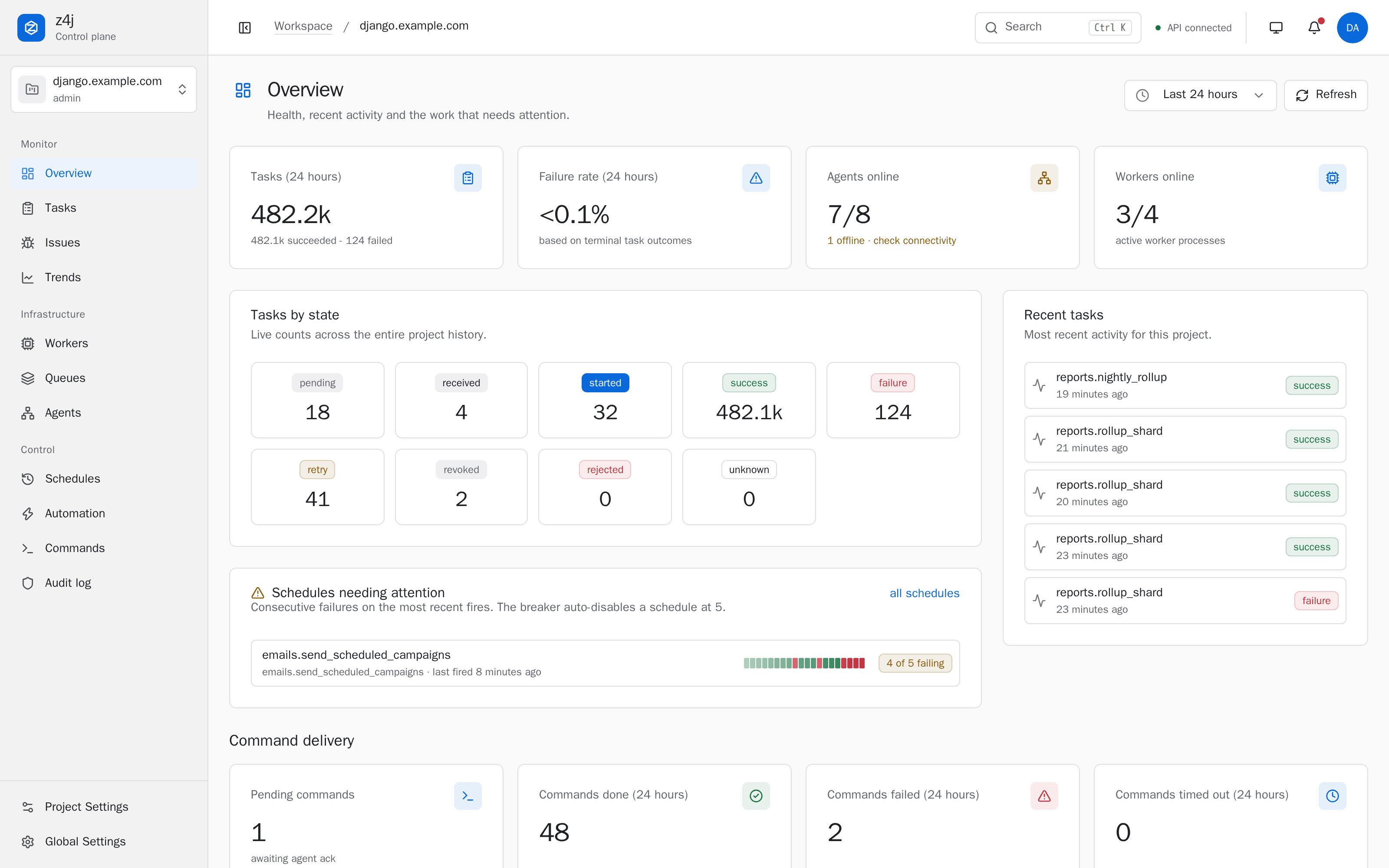
- Authoritative probes for Celery, RQ, arq, Huey, and taskiq where their result backends are configured; Dramatiq currently reports unknown because a message id alone lacks actor and queue context
- Engine-matched routing: reconcile calls go to an agent that actually runs that engine
- Source-anchored state updates (agent cannot spoof engine / task_id)
- Rate-limited to protect the broker and audit log
Safe worker restart
Capability-aware restart, zero shell execution.
Restart is a Celery control: z4j broadcasts pool_restart, which is fire-and-forget and requires Celery's worker_pool_restarts setting; z4j does not receive confirmation that the pool restarted. The brain admits a restart only for a worker whose single online reporting agent advertises the native action, so engines without a remote restart are never sent one.
- Celery: pool_restart broadcast; observe the worker afterwards because delivery and restart are not confirmed
- Other engines: no remote restart is offered, and the brain refuses one rather than improvise
- Targets one named worker with an unambiguous reporting agent
- Never executes shell commands
Related
More capabilities
Notification providers
Seven native channels. Plug into the stack you already use.
Learn moreMFA with TOTP, recovery codes, and trusted devices
RFC 6238 TOTP, single-use recovery codes, per-device 30-day trust cookie. WebAuthn deferred; no SMS or email second factors.
Learn moreRBAC built-in
Four roles. Project routes gated. UI mirrors server.
Learn more